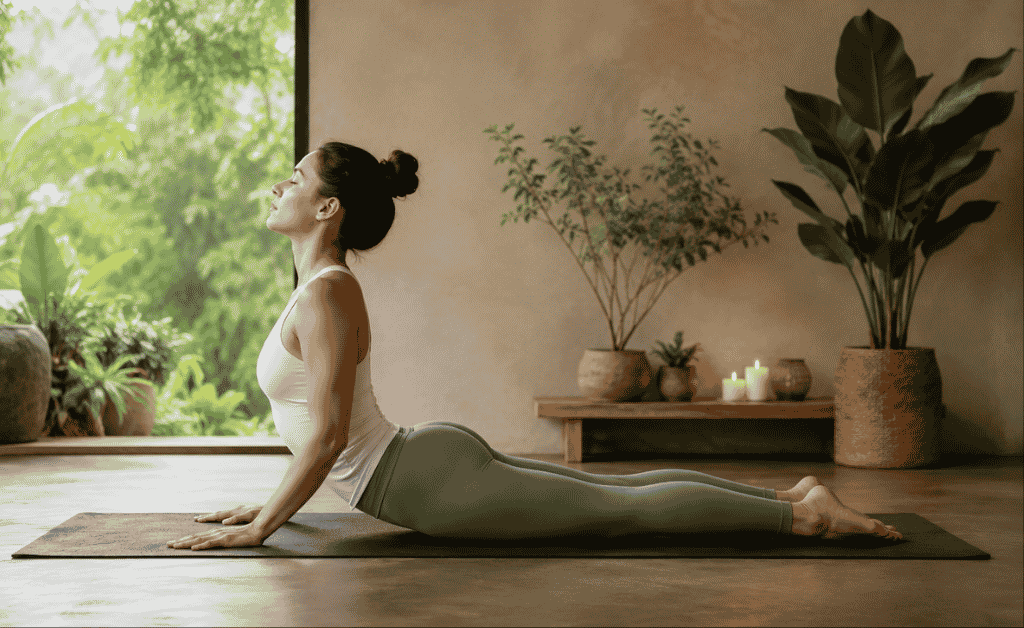
If you have ever watched a cobra rise up and spread its hood, you already have a picture of what this pose looks like. Bhujangasana, commonly called Cobra Pose, is one of the most well-known backbending poses in yoga. It is beginner-friendly, deeply effective, and takes only a few minutes to practice.
The name comes from two Sanskrit words: Bhujanga, meaning serpent or snake, and Asana, meaning pose. In yoga tradition, the cobra represents awakening, transformation, and inner strength. The chest-opening nature of this pose is connected to courage, confidence, and emotional release. It has been part of yoga practice for centuries and is even described in the 17th-century text Gheranda Samhita, which noted its ability to strengthen the spine and invigorate the body. Today it remains a core part of Surya Namaskar and many flow-based yoga sequences.
What Does Bhujangasana Do for Your Body?
Bhujangasana works on your body in several useful ways. Here is what regular practice can do:
Strengthens your back and spine: Lifting your chest off the floor activates your back muscles and glutes, which over time improves your posture and makes your spine stronger.
Increases flexibility: The pose gently stretches both your upper and lower back, making it easier to move without stiffness over time.
Opens the chest and shoulders: If you spend most of your day sitting at a desk, your shoulders tend to round forward. This pose works directly against that by expanding the chest and stretching the shoulders open.
Supports digestion: The gentle pressure on your abdomen while holding the pose stimulates your digestive organs and supports better metabolism.
Eases lower back tension: When done correctly, Cobra Pose strengthens the lower back safely and can reduce mild discomfort and stiffness in that area.
Boosts energy and circulation: The pose increases blood flow and stimulates the adrenal glands, which leaves you feeling more alert and energetic.
Activates the endocrine system: Bhujangasana stimulates the thyroid and adrenal glands, which supports hormonal balance in the body.
Reduces stress: Opening the chest naturally encourages deeper, slower breathing which calms the nervous system and eases tension.
Builds confidence: The expansive, upright posture of the pose has a natural effect on your mood and how you carry yourself.
How to Do Bhujangasana Step by Step
Warm Up First
Before you get into the full pose, prepare your spine, shoulders, and chest with these three simple warm-up poses:
Cat Cow: Get on your hands and knees. Breathe in as you drop your belly and lift your chest and tailbone up. Breathe out as you round your spine and tuck your chin. Repeat this six to eight times to gently warm up your spine.
Child's Pose: From kneeling, sit your hips back toward your heels and stretch your arms forward with your forehead resting on the mat. Hold for 30 to 60 seconds and let your spine lengthen with each breath.
Sphinx Pose: Lie on your stomach and place your forearms flat on the mat with your elbows directly under your shoulders. Lift your chest slightly using your back muscles and hold for 20 to 30 seconds. This is a gentler backbend that prepares you for the full pose.
The Full Pose
- Lie face down on your mat with your legs extended and the tops of your feet pressing gently into the floor. Rest your forehead on the mat.
- Place your palms flat under your shoulders with your fingers spread wide and your elbows close to your sides.
- Press your legs, thighs, and feet into the mat and lightly engage your glutes.
- Breathe in, press your pubic bone down, and lift your chest using your back muscles rather than pushing hard through your arms.
- Roll your shoulders back and down, broaden across your collarbones, and lift your chest forward.
- Straighten your arms as much as feels comfortable, keeping a soft bend in the elbows. Look forward or slightly upward with a relaxed gaze.
- Hold for 15 to 30 seconds if you are a beginner, or up to one to three minutes if you have more experience. Keep your breathing steady throughout.
- Breathe out and slowly lower your chest, shoulders, and forehead back to the mat.
Alignment Tips to Keep in Mind
- Keep your core engaged throughout to protect your lower back
- Do not overarch your lower back. Lengthen through your tailbone to keep the spine even
- Keep your shoulders away from your ears
- Avoid tilting your head too far back, which puts strain on your neck
- If your lower back feels uncomfortable, try placing a folded blanket under your pelvis
Variations for Every Level
Half Cobra (Ardha Bhujangasana) for beginners: Instead of pressing on your palms, keep your forearms on the ground with your elbows under your shoulders. Lift your chest gently and hold for 20 to 30 seconds. This is a great starting point if the full pose feels too intense.
Sphinx Pose for beginners: This variation also uses forearm support and is a safe and comfortable way to build endurance in the backbend position while expanding your chest. Hold for 30 to 60 seconds.
Twisted Cobra (Tiryak Bhujangasana) for intermediate: Start in the full pose, then on an exhale, gently twist your torso to one side and look over your shoulder. Hold for 15 to 20 seconds, return to center, and repeat on the other side. This adds spinal rotation and supports digestion.
King Cobra for advanced: From the full pose, bend your knees and bring your feet toward your head. If possible, lift higher and reach your head back toward your toes. Hold for 10 to 15 seconds with steady breathing.
One-Armed Cobra for advanced: Begin in Cobra Pose, then extend one arm backward along your side while pressing with the other arm to lift your torso. This challenges your balance and strengthens your back and core.
Who Should Avoid This Pose
Bhujangasana is generally safe, but there are situations where you should skip it or speak to a doctor first:
- Recent back surgery or serious back injury
- Herniated discs or chronic spinal conditions
- Pregnancy, especially in the second and third trimester
- Severe arthritis in the spine
- Recent abdominal surgery
- Severe migraines or frequent headaches
Practice with extra care if you have:
- Neck injuries: Keep your head in a neutral position and avoid tilting back
- Wrist pain: Use Sphinx Pose with forearm support instead
- High blood pressure: Stick to gentler versions and avoid deep lifts
- Menstruation: Listen to your body and move to gentler forward bends if needed
Always warm up before attempting this pose and exit slowly if you feel any sharp pain, dizziness, or discomfort.
Poses to Try After Bhujangasana
Once you finish Cobra Pose, these related poses pair well with it:
Seated Forward Bend (Paschimottanasana): A good counter-stretch that releases the back after a backbend.
Downward-Facing Dog (Adho Mukha Svanasana): Helps decompress the spine and cool down the body after the pose.
Camel Pose (Ustrasana): For those ready to go deeper, this pose opens the chest and shoulders further while strengthening the spine.
Bow Pose (Dhanurasana): Strengthens the full back and provides a whole-body stretch, a natural progression from Cobra.
A Simple Pose With Real Results
Bhujangasana does not ask much of you. A few minutes on your mat, consistent practice, and attention to alignment. In return, it strengthens your spine, opens your chest, supports your digestion, and helps you manage stress better over time.
Whether you are new to yoga or have been practicing for years, Cobra Pose has something to offer. Start with the half pose or Sphinx if you need to, and build from there at your own pace.
References:
https://myyogateacher.com/yoga-asana/bhujangasana
https://gurukulyogashala.com/blog/bhujangasana-or-cobra-pose
Disclaimer:
The information in this blog is for educational purposes only and should not be treated as medical advice. The yoga poses and instructions described here are general guidance and may not suit everyone. If you have any existing health conditions, injuries, or physical limitations, please consult your doctor or a qualified healthcare professional before starting any yoga practice. We do not guarantee specific results from practicing Bhujangasana or any other pose mentioned in this blog, as individual results may vary. Always listen to your body and stop immediately if you feel any pain or discomfort during practice.